There is a particular kind of organizational denial that afflicts nonprofits — and, to be fair, most small businesses, certain municipal governments, and at least one university you can probably name — in which a website is launched with great fanfare, updated with genuine enthusiasm for approximately four months, and then left to its own devices for what everyone privately understands to be far too long.
The staff reassures itself that the site is "basically fine."
The site is not basically fine.
It is doing the digital equivalent of sitting in the lobby with its collar askew, hoping no one looks too closely. It is your organization's public face, greeting donors, grant reviewers, prospective volunteers, and the families you serve — often before any human being has had a chance to make a first impression.
It has been running on borrowed time since the Obama administration.
The good news is that nonprofit website maintenance, unlike most problems in the sector, is eminently manageable. The first step, as in most things, is knowing what to look for. Here are the five signs that your website has quietly moved from "maintained" to "in need of serious attention."
Sign 1: Does Your Staff Page Still Show People Who've Already Left?
An outdated staff page is the single most reliable indicator that a website has outgrown whatever maintenance arrangement — or absence of one — is currently in place.
The staff page — that earnest gallery of headshots and brief bios, assembled with such care when the site was new — has quietly become a kind of institutional yearbook, commemorating colleagues who have since moved on to other organizations, other cities, or, in a few notable cases, other fields entirely.
Visitors notice this. Particularly potential major donors conducting the preliminary research that precedes a significant gift.
They may not say so. They will simply wonder, with a degree of unease that is difficult to quantify but very easy to feel, whether the organization is as attentive to its work as it is to its website.
The answer, of course, is almost certainly yes. The impression, however, is something else.
A living staff page — one that reflects who actually works at your organization, with titles that match current job descriptions and photographs taken in the current decade — is one of the clearest signals an organization can send that someone is paying attention. It is also, in a well-run monthly website maintenance routine, one of the first things checked.
Sign 2: Could Your Donation Form Be Broken Right Now Without Anyone Knowing?
Yes — and more often than most organizations would like to believe. A broken donation form is the defining nightmare of nonprofit website neglect precisely because it fails silently, without error messages, while the organization continues in confident ignorance.
Here is a small horror story for development directors: the donation form on your website stopped working three weeks ago.
Not dramatically — no error messages, no site-wide failure, nothing that would trip an alarm. It simply stopped sending confirmation emails. Or the payment processor updated its API. Or a wordpress plugin conflict introduced a silent failure that accepts donations but doesn't record them properly.
You don't know about it because no one told you.
No one told you because the form appears, to any casual observer, to be functioning normally. Donors clicked through, saw a confirmation page, and assumed everything was fine.
Meanwhile, somewhere in the gap between your WordPress installation and your CRM, a quiet catastrophe has been unfolding.
This is not a hypothetical. It happens with some regularity — and it is substantially more common in the weeks and months following any WordPress update, when plugins and themes and core files renegotiate their relationships in ways that are not always graceful.
The fix, once discovered, is usually straightforward. The discovery, without someone actively monitoring, can take an uncomfortably long time.
Sign 3: Does Your Website Load With the Urgency of a Committee Decision?
A website that takes more than three seconds to load has already lost a measurable percentage of its visitors — visitors who left without announcing their departure and will not be coming back.
Patience, in the context of web browsing, is not a virtue most visitors possess.
Research on user behavior has, for years, confirmed that the willingness to wait for a page to load diminishes rapidly after the first two or three seconds. Visitors who leave never particularly announce their departure. They are simply gone, off to any one of the thousands of other things competing for their attention, while your site continues its measured, contemplative approach to rendering.
Page speed is a function of several interrelated factors: image sizes, plugin accumulation, hosting quality, code bloat.
A WordPress site that has been in operation for several years without wordpress website maintenance will frequently have acquired, in the manner of certain attics, a remarkable quantity of items that nobody remembers acquiring and nobody has gotten around to removing. Plugins installed for a single event in 2020. Images uploaded at full resolution because compressing them seemed like a task for later. A theme that has not been updated since its developer moved on to other projects.
None of this is unusual. All of it is addressable.
And addressing it has the agreeable side effect of improving your site's standing with Google, which rewards fast-loading sites and quietly penalizes the contemplative ones.
Sign 4: Has Your Site's Design Quietly Drifted Into Incoherence?
Design drift — the gradual visual degradation that results from years of content updates made without design oversight — is one of the most consequential and least-discussed consequences of inadequate nonprofit website maintenance.
A website, when it launches, has a certain visual logic — a palette, a typographic system, a way that pages relate to one another.
This logic, in the absence of consistent stewardship, erodes.
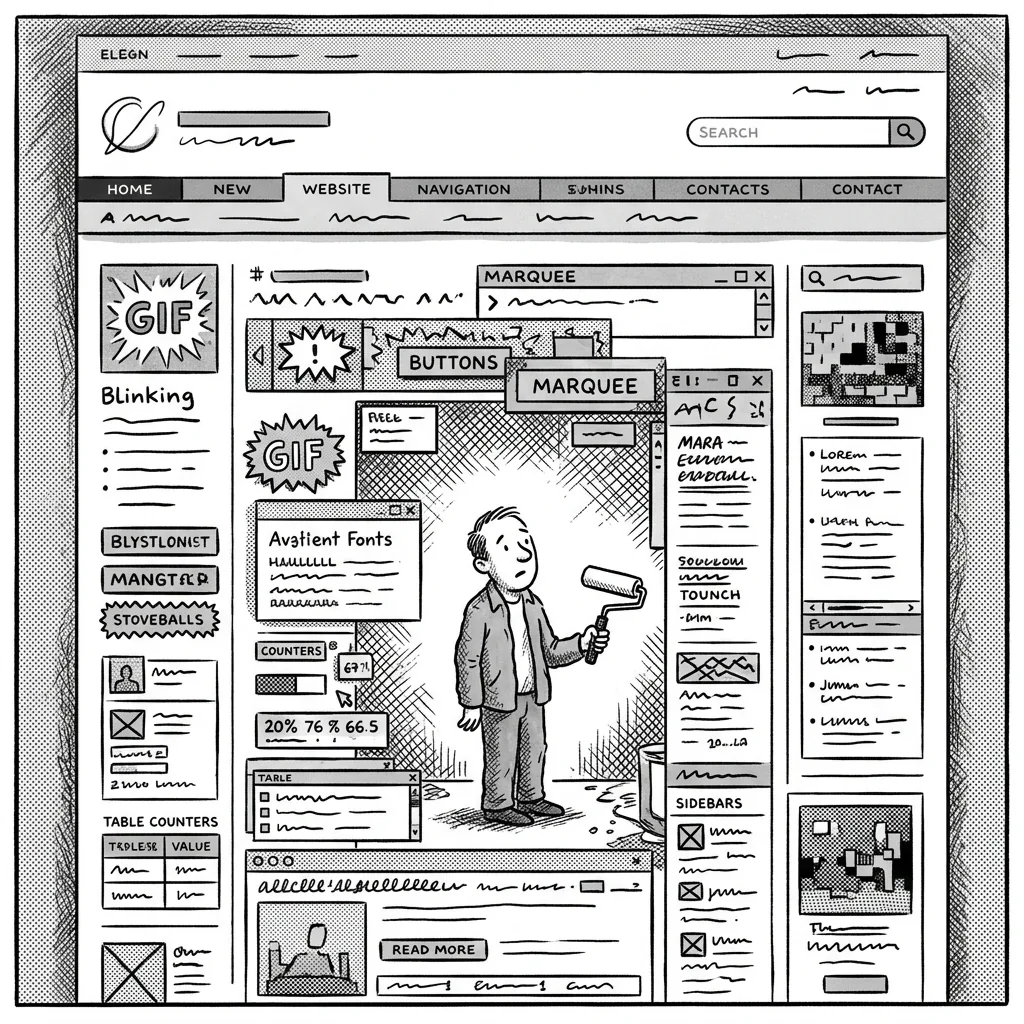
A new program page gets added by someone who wasn't entirely sure which template to use. A banner image gets stretched to fit a space it wasn't designed for. A sidebar that once balanced a page now lists slightly to one side.
None of these are catastrophic in isolation. Taken together, over years, they produce a site that feels — to a careful observer — slightly off. A place where the parts don't quite add up to a coherent whole.
This matters more than most organizations realize. Donors, in particular, are pattern-matching creatures. They are reading your website not just for information but for evidence that your organization operates with care and intention.
A site that looks like it has been assembled by a succession of well-meaning volunteers — even if it has — communicates something different than one that reflects a unified point of view.
The issue is not design sophistication. It is consistency. A simple site, maintained with a regular design eye, will nearly always outperform a beautiful site that has been allowed to drift.
Sign 5: Does Anyone Actually Know Who Is Responsible for Your Website?
The most diagnostic sign of all is not technical — it is organizational. When website responsibility is unclear or distributed across multiple people with competing priorities, consistent nonprofit website maintenance becomes structurally impossible.
Ask, in any staff meeting, who is responsible for the website. Watch the glances. Note the careful qualifications — "I handle content updates when I can" and "technically it's under communications but we don't really have a communications person right now" and the ever-reliable "we have a board member who knows WordPress."
The board member who knows WordPress is a beloved figure in nonprofit life. They step in during emergencies with genuine goodwill and varying degrees of success.
They are not, however, a maintenance strategy.
Monthly website maintenance requires not just technical knowledge but consistency — a regular rhythm of updates, backups, monitoring, and review that doesn't depend on whether this particular board member is available, or whether the communications intern has cycles this week, or whether the executive director can carve out a Saturday afternoon to figure out why the homepage slider has stopped working.
When no one owns the website, the website — slowly, politely, and without drama — begins to own you.
What Should a Connecticut Nonprofit Do About These Signs?
If your organization recognizes more than one of these signs, the answer is a website care plan — a monthly arrangement, either internal or outsourced, that places website maintenance in the hands of someone specifically responsible for it.
The path forward is less complicated than the accumulated neglect might suggest.
A website care plan provides what most nonprofit websites have been lacking: regular attention from someone who notices when something is wrong before it becomes a problem that a donor notices first. For Connecticut nonprofits specifically, that means a partner who understands the local context — the particular budget constraints, the stretched staff, the complex audience of donors, clients, volunteers, and grant reviewers that a small organization's website must simultaneously serve.
What you need is not a digital agency with enterprise pricing and a project manager you'll never meet. You need a partner who understands the nonprofit context, who can be reached when something breaks before your year-end campaign, and who brings, alongside the technical competence, enough of a design sensibility to notice when your site is starting to look like it was assembled by committee.
Which, through no fault of your own, it may well have been.
Vivienne is a website care practice built specifically for Connecticut nonprofits. We handle updates, security, backups, and the design details that tend to get lost in the shuffle — so your site continues to represent your organization the way it should. [Explore our care plans →]